The Balama Project is situated in the Cabo Delgado province of northern Mozambique, some 200km west of the port town of Pemba. Mozambique gained its independence from the Portuguese in 1975 which lead to a protracted fifteen year civil war lasting until 1992. Two years later Mozambique held its first multiparty elections and has remained a republic ever since. The country has maintained political stability and has gone from strength to strength - it is one of the fastest growing economies in Africa. Although a great portion of their economy is based largely on agriculture other industries such as aluminium and petroleum production, chemical manufacturing and tourism are growing.
Balama graphite was first documented in 1893 by John H. Furman, a geologist and engineer working for the Nyassa Company. The Nyassa Company was incorporated as a Portuguese company but it was part owned by British and French interests. The company was granted a charter, to establish economic development and administer the leased territories (Cabo Delgado province as well as islands off the coast of Mozambique) by the Portuguese government. Accordingly, the company sent a number of experts on expeditions through these areas to establish an inventory of resources.

In his report John H. Furman states, "north of Mualia [now the village of Maputo], I discovered the greatest deposits of graphite, of a most excellent quality, which I think have ever been found. They extend several miles in length and will aggregate more than 700ft [214m] in thickness." Now it seems that Mr Furman was prophetic in his observation because 120 years later, in 2013, Syrah Resources announced the largest graphite resource ever defined at the time.
(1) Refer to ASX announcements 29 May 2015 and 15 November 2016
| Operations Summary | |
|---|---|
| Location | Mozambique (Cabo Delgado Province) |
| Reserves1 | 114.5Mt at 16.6% TGC2 (18.9Mt of contained graphite) |
| Resources1 | 1,191Mt at 11.0% TGC2 (128.5Mt of contained graphite) |
| Life of Mine | Over 50 years |
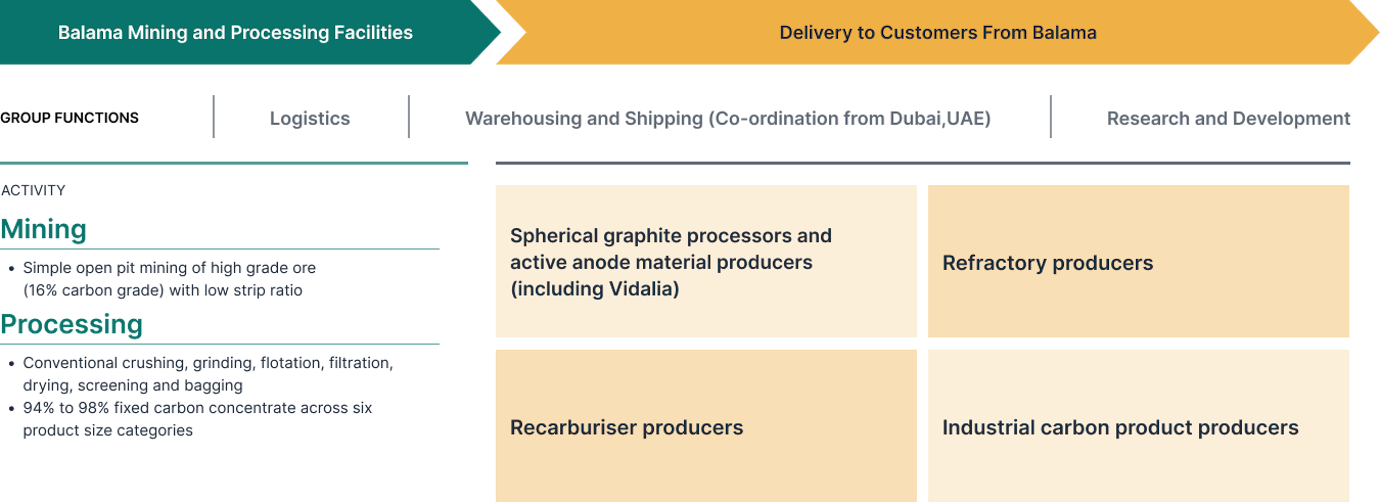
| Mining | Simple, open pit operation with low stripping ratio |
| Processing | Conventional processing including crushing, grinding, flotation, filtration, during, screening and bagging |
| Processing Plant Capacity | 2Mt ore per annum |
| Nameplate Capacity | 350kt of graphite concentrate per annum |
| Product | 95% to 98% Fixed Carbon concentrate across a range of flake sizes |

Mining
Balama West, including Mualia will be initially mined with free dig open pit mining. At full capacity this will provide approximately 2Mtpa of ore to the process plant with a head grade between 16-18% Total Graphitic Content (TGC).Sub grade ore between great than 2% and less than 9% continues stockpiled for future processing. Following completion of open pit mining at Balama West, mining will continue at Balama East.
Balama Mine Layout
| Mining Fleet | |
|---|---|
| 2 x Liebherr 974 Excavator | 1 x Liebherr 964 Excavator (back up> |
| 9 x Bell B40 ADT Trucks (40 tonne) | 6 x Sino Howo Rigid Trucks (50 tonne) |
| 1 x Cat D8 Dozer | 1 x Cat 140H Grader |
| 2 x 20kl Water Trucks | 2 x Cat 986 Loaders (feeding plant) |
| 1 x Lot Support Auxiliary Equipment |
| Date | Balama Project Development Timeline |
|---|---|
| Nov 2018 | Syrah successfully produced 98% fixed carbon grade graphite using standard flotation processes |
| Apr 2018 | Balama inauguration with official opening by President Filipe Nyusi |
| Jan 2018 | Balama transitioned to operations, sales commenced |
| Dec 2017 | First natural fines flake graphite production achieved |
| Nov 2017 | First natural coarse flake graphite production achieved |
| Nov 2016 | Balama Ore Reserve upgrade to 114.5Mt at 16.6% Total Graphitic Carbon (TGC) for 18.6Mt of contained graphite (ASX Announcement) |
| Jul 2016 | Construction of Balama process plant commenced |
| Jun 2015 | All key regulatory approvals for Balama Project received |
| May 2015 | Balama Graphite Feasibility Study completed |
| May 2015 | Balama maiden JORC compliant Ore Reserve declared |
| Jul 2014 | Vanadium scoping study finalised |
| Dec 2013 | Government of Mozambique grants 25 year Mining Licence with further 25 year extension available for the Balama Project for graphite and vanadium |
| May 2013 | Maiden Balama East Inferred Resource announced |
| Jan 2013 | Maiden Balama West Inferred Resource announced and is the largest known graphite deposit in the world |
| Jul 2012 | Early stage trenching program indicates vanadium grades |
| May 2012 | Diamond drilling commenced at Balama Project |
Processing
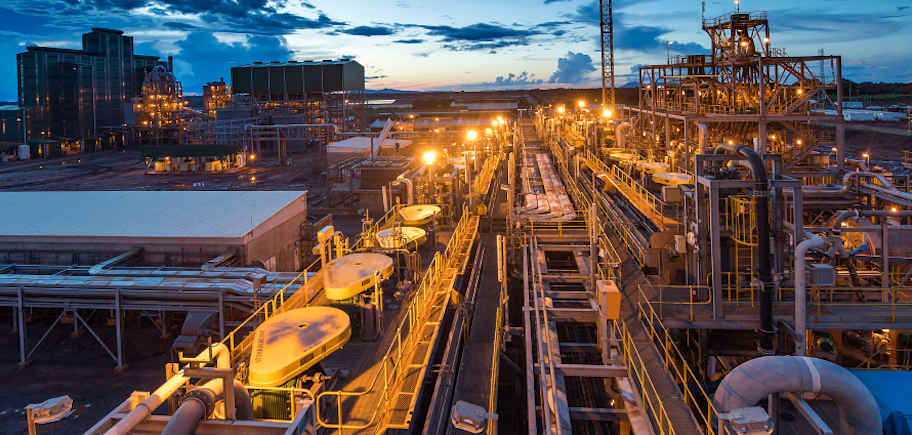
The Balama processing plant has a feed rate of 2Mtpa using conventional processes including:
Waste material is pumped to the Tailings Storage Facility after the graphite flotation process.
(1) Secondary milling process separating the coarse and fine flake circuits
Based on the current mine plan, the recovery target for the earlier periods is 88% then gradually increasing to feasibility study range of 92.5%.

Other Facts
Flotations Cells: At Balama, there are 51 flotation cells, in three groups of flotation cells banks:
Attrition Cells: Attrition cells allow for fixed carbon grade of 96-98%. The process used by the attritions cell is very simple and involves the removal of gangue minerals from graphite particles, which cleans the surface of the particles and improves flotation efficiencies downstream without a significant impact on particle size. The attrition cells became operational in August 2018 (ASX Announcment) and Syrah achieved its first spot sale of 98% fixed carbon grade product in November 2018 (ASX Announcment). Under normalised production, Syrah’s natural flake graphite fixed carbon (FC) grade is expected to be a baseline minimum of 95% FC. Historically for every 1% increase in FC grade attracts a premium in price of approximately 4%-7% per tonne. The majority of exiting production of natural flake 98% FC requires chemical purification, whereas Syrah has successfully produced 98% FC products via standard flotation process. Chemical purification adds significant unit operating costs relative to Syrah’s use of attrition cells.

Value in use advantages for Syrah’s customers and supply chain include:
Syrah expects higher selling prices for higher grade FC due to the cost differential and value in use providing a pricing premium. The combination of Flotation control performance and liberation from milling and attrition cells are critical for recovery and quality. The Balama circuit is designed with enough phases and combinations to allow for maximum performance.
.jpg)
Chipembe dam

Power station

Bitumen road to the Balama Project
Logistics
The Balama Project is connected by a bitumen road to the Port of Nacala, some 490km south east of the project. Nacala is a major port in Mozambique and the deepest port in southern Africa. There are twin berths for containers with a total length of 395m as well as four berths for bulk traffic with a total length of 600m. Balama graphite will be packed into one tonne bags, hauled by road to Nacala and then packed into 20 foot containers for export. The Nacala port will be ample for the volumes proposed by the Balama Operation. The port is serviced by major international container carriers.
Syrah’s graphite distribution and logistics services have been contracted out to a third party for an initial term of five years (ASX announcement).
Water
A water licence has been granted to Syrah. Water for Balama is supplied from the Chipembe Dam which has a capacity of approximately 25 million m3 and is located 12km from the Balama Operations. Syrah’s Water License allows two million m3 of water to be drawn from the Chipembe Dam annually which is sufficient for its demands.
Power
Balama is powered by a 15.4 MW diesel driven power station comprised of seven 2.2MW generators. The power station will provide sufficient electricity for Balama to operate independently without any requirement to access grid power. Currently, power supply from the main grid remains intermittent.
Plant Site Buildings
| (US Mesh) | (µm) | Description | Average Size Distribution |
Application |
|---|---|---|---|---|
| +50 | >300 | Extra large | 8% | Traditional uses (e.g steelmaking, iron castings, foundries, automotive parts, lubricants) |
| +80 | <300 - >180 | Large | 12% | Traditional uses (e.g steelmaking, iron castings, foundries, automotive parts, lubricants) |
| +100 | <180 - >150 | Medium | 12% | Traditional uses (e.g steelmaking, iron castings, foundries, automotive parts, lubricants) |
| -100 | <150 - >106 | Fines | 68% | Spherical graphite for anode in Lithium Ion batteries and recarburiser products |
(1) Average estimated size distribution over the LOM based on Snowden Feasibility Study. Refer to ASX announcement “Balama Feasibility Study and Corporate Presentation” on 29 May 2015.
Fixed carbon (FC) grade will range from 95% to 98% inclusive.
What does mesh size mean? - The mesh size refers to the number of openings in a one inch screen. A 100 mesh screen has 100 openings etc. As the mesh size number increases, the size of the particles decreases with higher numbers indicating finer material.
What does minus (-) and plus (+) signs mean when describing mesh sizes? - -100 mesh means that all particles smaller than 100 mesh would pass through +100 mesh means all particles 100 mesh or larger are retained.
Syrah has received the following key government approvals for the Balama Operation.
| Approval | Grant date | Term |
|---|---|---|
| Mining Concession | 6 December 2013 | 25 years (renewable) |
| Water License | 22 November 2014 | 10 years (renewable) |
| Environmental License | 23 April 2015 | 5 years (renewable) |
| Land Access (DUAT) Lincese | 22 June 2015 | 23 years (renewable) |